
UGC Care vs Scopus vs Web of Science: Which Journal Should You Choose for Your Research Paper in 2026?
UGC Care vs Scopus vs Web of Science: Which Journal Should You Choose for Your Research Paper in 2026?
If you're a PhD scholar, M.Tech student, or faculty member preparing a manuscript, you've probably run into the same wall: your guide says "publish in a good journal," but nobody explains what "good" actually means. UGC Care, Scopus, and Web of Science (WoS) get used almost interchangeably in casual conversation — but they are three very different systems, built for three different purposes, and picking the wrong one can cost you months of review time or even derail a viva or grant application.
This guide breaks down exactly how these indexing systems differ, which one fits your specific situation, and how to avoid the mistakes that get papers stuck in endless revision cycles.
Why This Decision Matters More Than It Seems
Choosing a journal isn't just about "getting published." It affects:
- Eligibility — many Indian universities require a specific index (usually UGC Care) for PhD submission, while postdoc and international grant applications often expect Scopus or WoS.
- Timeline — UGC Care and ESCI journals typically move faster than SCI/SCIE tier journals, which can take 6–18 months through peer review.
- Cost — article processing charges (APCs) vary from zero to well over $1,000 depending on the journal and its indexing tier.
- Career weight — Scopus and WoS-indexed papers generally carry more weight for postdoc applications, international collaborations, and citation-based evaluations like the h-index.
Picking the right index before you write your manuscript — not after your first rejection — saves the most time.
What Is UGC Care?
UGC Care (Consortium for Academic and Research Ethics) is a journal quality list maintained by India's University Grants Commission. It exists specifically to filter out predatory and low-quality journals for Indian academic use.
Best for:
- PhD thesis submission requirements at Indian universities
- Faculty appraisal (API/PBAS scoring) at Indian institutions
- M.Tech scholars who need a fast, India-recognized publication
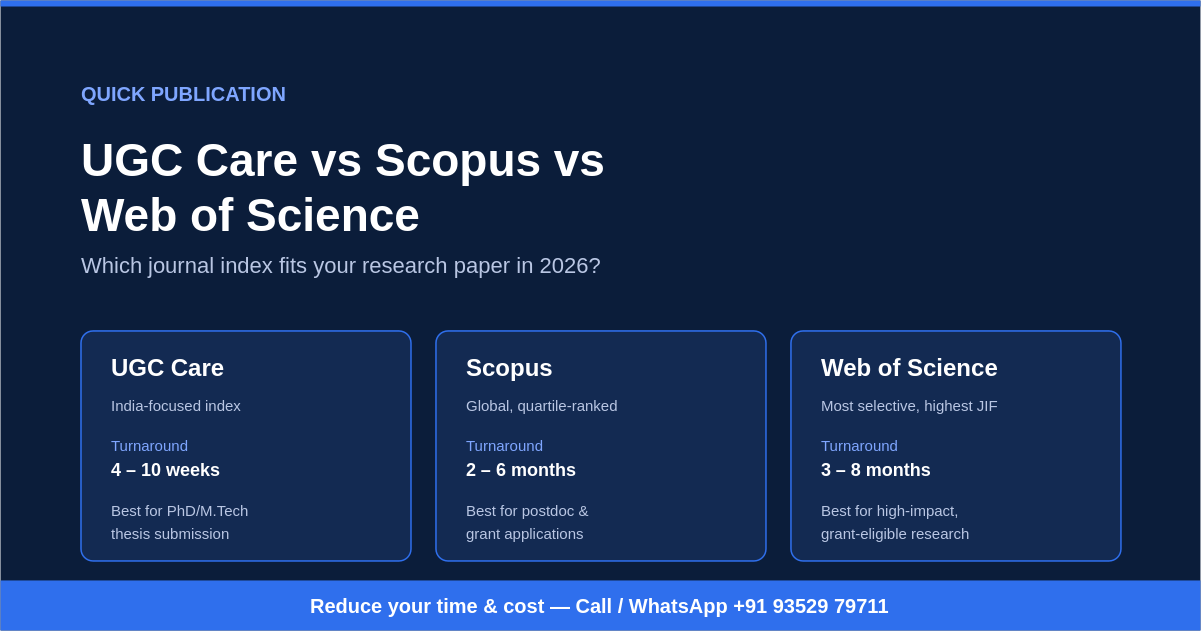
Typical turnaround: 4–10 weeks, though this varies significantly by journal and how "review-ready" your manuscript is.
Limitation: UGC Care recognition is primarily relevant within India. It carries little to no weight for international postdoc or grant applications.
What Is Scopus?
Scopus is Elsevier's international abstract and citation database, covering peer-reviewed literature across science, technology, medicine, and social sciences. Journals are categorized into quartiles (Q1–Q4) based on their CiteScore, giving you a quick sense of a journal's relative standing within its field.
Best for:
- International visibility and citation tracking
- PhD scholars applying for postdoc positions or fellowships abroad
- Researchers who need quartile ranking (Q1/Q2) for grant or scholarship eligibility
Typical turnaround: 2–6 months, depending on quartile — Q1/Q2 journals are more selective and slower; Q3/Q4 journals move faster but carry less prestige.
Limitation: Selectivity and cost rise sharply as you move toward Q1 journals. Manuscripts with weak novelty, poor English, or high similarity scores get desk-rejected quickly.
What Is Web of Science (WoS)?
Web of Science, maintained by Clarivate, is generally considered the most selective of the three. It includes the Science Citation Index Expanded (SCIE), Social Sciences Citation Index (SSCI), and Emerging Sources Citation Index (ESCI) — plus the SCI tier for the highest-impact core science journals.
Best for:
- High-impact research with strong methodological rigor
- Researchers targeting Journal Impact Factor (JIF) — a metric that specifically comes from WoS, not Scopus
- Grant applications and international faculty positions that explicitly ask for WoS/SCI-indexed output
Typical turnaround: 3–8 months for SCIE; ESCI (the entry tier under WoS) tends to move faster, in the 6–12 week range.
Limitation: The highest tiers (SCI/SCIE) demand strong original contribution, thorough literature review, and statistically sound results — a rushed or thin manuscript is unlikely to survive review.
UGC Care vs Scopus vs Web of Science: Side-by-Side Comparison
FactorUGC CareScopusWeb of ScienceMaintained byUGC (India)ElsevierClarivatePrimary use caseIndian PhD/faculty requirementInternational visibility, quartile rankingHigh-impact research, Journal Impact FactorTypical review time4–10 weeks2–6 months3–8 months (ESCI faster)Recognition scopePrimarily IndiaGlobalGlobalRelative selectivityModerateModerate to high (varies by quartile)High (especially SCI/SCIE)Common APC rangeFree–₹15,000Free–$1,500+Free–$2,000+Ideal forThesis submission, faculty appraisalPostdoc/grant applications, citation trackingGrant eligibility, high-impact publication record
How to Decide Which One Is Right for You
Ask yourself these three questions before you write a single line of your manuscript:
1. What does your university or guide actually require?
Check your department's PhD/M.Tech regulations first — many explicitly name UGC Care as the minimum requirement, with Scopus or WoS as optional "bonus" criteria.
2. What's your realistic timeline?
If you're on a deadline for a semester submission or viva, UGC Care or ESCI-tier journals are far more predictable than chasing a Q1 Scopus or SCI journal.
3. Is this paper for career advancement beyond your degree?
If you're aiming for a postdoc, international collaboration, or research grants, investing the extra months into a Scopus Q1/Q2 or WoS SCIE paper pays off far more than a fast UGC Care listing.
A common and effective strategy: publish early-stage or conference-extension work in UGC Care or ESCI journals for speed, and reserve your strongest, most original results for a Scopus or WoS submission.
Common Reasons Papers Get Rejected — Regardless of Index
Across all three indexing systems, the same issues keep showing up in rejection and revision requests:
- High similarity/plagiarism scores — most journals now enforce strict Turnitin-style thresholds, often under 15–20%.
- AI-generated content flags — journals increasingly run AI-detection checks alongside plagiarism checks, and flagged manuscripts get sent back or rejected outright.
- Weak literature review or unclear novelty — reviewers reject papers that don't clearly state what's new compared to existing work.
- Formatting inconsistencies — citation style, section structure, and journal-specific templates matter more than most first-time authors expect.
Addressing these before submission — not after a reviewer flags them — is the single biggest factor in cutting your time-to-publication.
Final Thoughts
There's no universally "best" option between UGC Care, Scopus, and Web of Science — only the option that's best for your specific paper, timeline, and career stage. Match the index to your requirement first, then build your manuscript, plagiarism check, and formatting strategy around that target.
If you'd rather not navigate journal shortlisting, formatting, and reviewer responses on your own, Quick Publication offers a free manuscript evaluation that recommends the right indexing category — UGC Care, Scopus, WoS, SCI, SCIE, or ESCI — based on your specific research area and timeline. Explore our journal publication services →
Frequently Asked Questions
Is Scopus better than UGC Care?
Neither is universally "better" — they serve different purposes. UGC Care is generally required for Indian PhD/faculty submissions, while Scopus offers broader international recognition and quartile-based ranking useful for postdoc or grant applications.
Can a journal be both UGC Care and Scopus indexed?
Yes, many journals hold multiple indexations simultaneously, which is often the most efficient option if your university requires UGC Care but you also want international visibility.
Which is faster: UGC Care or Web of Science?
UGC Care and ESCI-tier WoS journals typically move faster (4–12 weeks) than SCI/SCIE-tier WoS journals or Q1 Scopus journals, which can take several months due to more rigorous peer review.
Do UGC Care journals have an impact factor?
No. Journal Impact Factor (JIF) is a Clarivate/Web of Science metric. UGC Care journals do not carry a JIF unless they are also separately indexed in WoS.
How do I check if a journal is genuinely UGC Care, Scopus, or WoS indexed?
Always verify directly on the official UGC Care list, the Scopus source list, or Clarivate's Master Journal List rather than trusting a journal's own website claims — this is the single best way to avoid predatory journals.